Myth: A wallet that “simulates” transactions removes all risk — why that is wrong and how to use simulation properly with Rabby
Many DeFi users assume that a wallet with transaction simulation is an automatic safety shield: if the wallet simulates the tx and shows a sane balance change, the transaction must be safe. That belief is seductive because simulation converts abstract smart‑contract code into readable numbers. But simulation is a tool, not a guarantee. This article explains what transaction simulation does, where it helps most, the attack surfaces it cannot close by itself, and how to combine Rabby Wallet’s simulation and other features to materially reduce operational risk when you interact across dozens of EVM chains.
The audience here is the experienced DeFi user in the United States who needs a practical, decision‑useful mental model: when to trust a simulation, the kinds of vulnerabilities it catches, which it won’t, and the procedural controls you should still run. I focus on mechanism and trade‑offs, using Rabby’s documented features—transaction simulation, pre‑transaction risk scanning, automatic network switching, approval revocation, cross‑chain gas top‑up, and hardware wallet integrations—to show how to translate simulation into a defensive routine rather than a false promise.
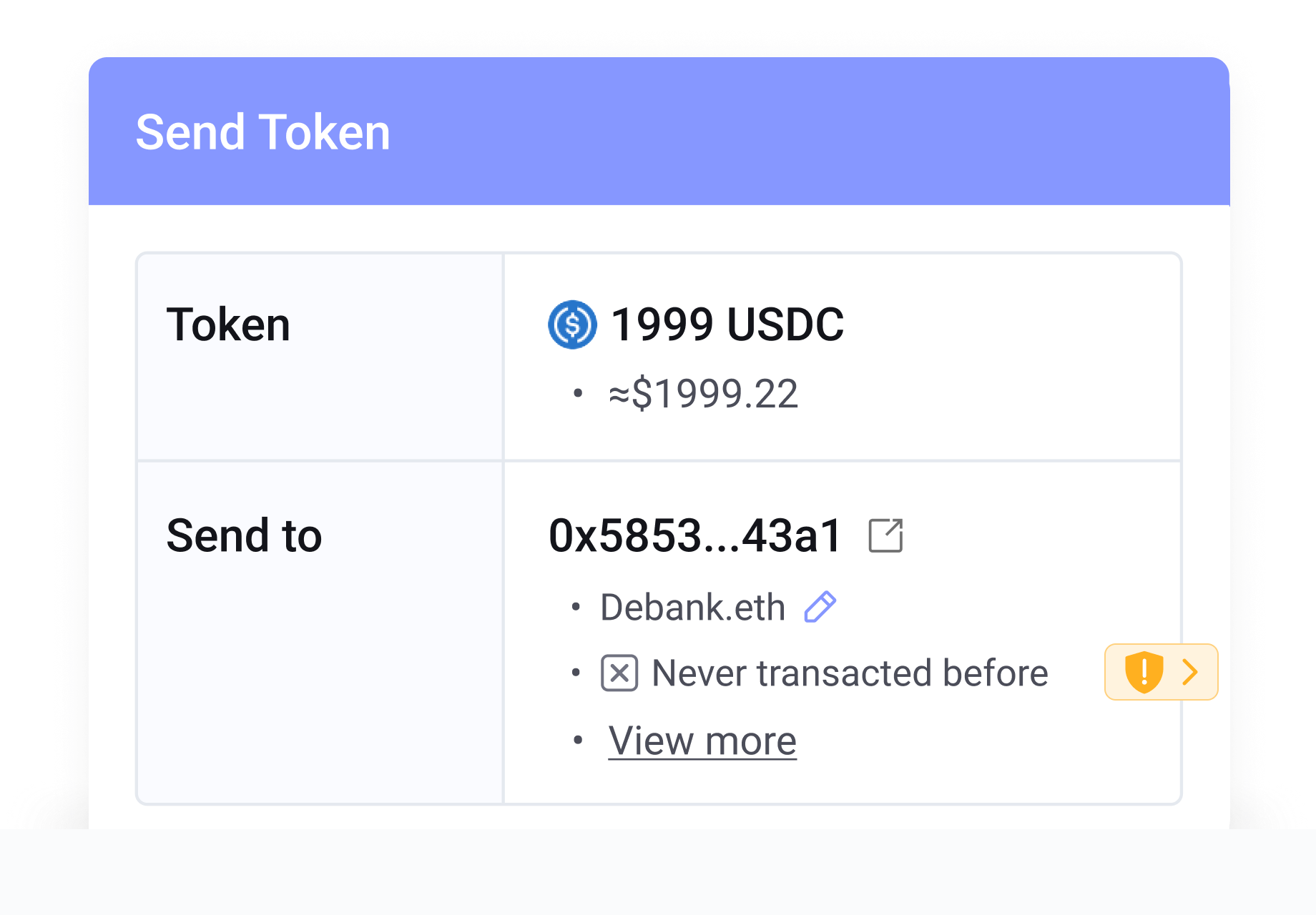
What transaction simulation actually does (mechanics, not marketing)
At its core, transaction simulation runs the intended transaction against a node or a local EVM instance to produce an expected state transition and gas estimate before you sign. That output can include: estimated token balance deltas for each asset, gas costs denominated in native chain token, and revert traces if the call would fail. Rabby surfaces these results to prevent “blind signing” — the dangerous case where users sign an opaque payload without seeing the concrete effect on balances.
Mechanistically, simulation helps in two distinct ways. First, it checks the concrete call path and computes token flows that smart contract code will produce with current on‑chain state. That catches simple but common problems: mistaken destination addresses, unintentionally large token transfers, and some classes of slippage or rounding errors. Second, simulation combined with a security engine (Rabby’s pre‑transaction risk scanning) can flag matches to known bad patterns — approvals to widely known exploited contracts, previously hacked addresses, or suspicious approval requests. Put together, these two capabilities raise the bar for opportunistic mistakes.
What simulation does not do (the limits)
Simulation has clear boundaries. It assumes current chain state and does not predict future on‑chain events. If a mempool frontrunner or a sandwich bot inserts competing transactions between the simulated state and when your transaction is mined, the actual outcome can differ. Simulation also assumes the node used for the run has the same view and gas model as the miner that ultimately includes your tx — differences in orphaned blocks, reorgs, or gas repricing can change costs and outcomes.
Critically, simulation cannot prove a contract’s economic safety. It shows what will happen with the code as executed, but it cannot detect logic that behaves badly under rare conditions or that intentionally hides pathways (e.g., an upgradeable contract that swaps logic after you approve it). Also, simulation depends on accurate ABI decoding; obfuscated calls or nonstandard proxy patterns may be simulated incorrectly or displayed in a way that looks innocuous when it isn’t.
How Rabby’s feature set changes the operational trade‑space
Rabby combines several defensive primitives that improve the utility of simulation if you use them together. Transaction simulation paired with pre‑transaction risk scanning means you not only see numeric deltas but are alerted if the target contract has a history of exploitation or if the approval pattern matches known risky schemes. Automatic network switching eliminates a class of user errors where one signs on the wrong chain — a surprisingly common vector for lost funds when interacting with multi‑chain bridges or forked dApp fronts.
Rabby’s built‑in approval revocation shrinks the window of exposure after you’ve granted permissions: if a contract’s behavior looks odd, you can remove its allowance without exporting to an external explorer. Hardware wallet compatibility adds a second, stronger root of trust: keys remain on device, and Rabby acts as the UX layer. Cross‑chain gas top‑up is operationally useful in multi‑chain flows; it reduces risky ad‑hoc transfers of tokens to unknown addresses just to pay gas on an unfamiliar chain. Each feature addresses different failure modes — simulation helps understand an individual call, revocation limits long‑tail exposure, hardware wallets protect keys, and gas top‑up reduces ad‑hoc, error‑prone steps.
Three practical routines that use simulation defensively
Below are repeatable procedures that convert Rabby’s technical capabilities into lower risk behavior. Think of them as checklists rather than guarantees.
Routine A — High‑value DeFi trade: 1) Check dApp network and let Rabby auto‑switch; 2) Connect using a hardware wallet; 3) Use simulation to verify exact token deltas and fee; 4) Confirm pre‑transaction risk scan shows no red flags; 5) If approving tokens, set a minimal allowance and revoke previous broad approvals via Rabby’s revocation tool.
Routine B — Cross‑chain bridge or swap: 1) Simulate the entire bridge call locally if possible; 2) Use Rabby’s cross‑chain gas top‑up rather than sending funds to a bridged address to cover gas on the destination chain; 3) Watch gas estimate vs. wallet balance; 4) Post‑tx, verify balances and revoke any temporary approvals.
Routine C — Quick NFT or token interaction from a new dApp: 1) Simulate with Rabby; 2) If simulation shows unexpected transfers or transfers to non‑existent addresses, stop; 3) If you must proceed, use a smaller test amount or a separate hot wallet with minimal funds.
Myth‑busting: common misconceptions and the corrective
Misconception 1: “Simulation equals audit.” Corrective: Simulation inspects an execution trace for a single state snapshot, but it does not analyze long‑term token economics, governance risk, or off‑chain triggers. Use audits and reputation signals in addition to simulation for high‑stakes interactions.
Misconception 2: “If a wallet flags a contract as hacked, it’s unsafe forever.” Corrective: Contracts can be patched, frozen, or re‑deployed. A history of exploitation is a strong signal of caution but not an absolute binary. Investigate whether a freeze/compensation occurred or whether governance has remedied the vector.
Misconception 3: “Automatic network switching is risky.” Corrective: Manual network errors are common; automatic switching reduces that risk. However, automatic switching magnifies phishing risks from malicious dApp fronts that force different networks. Always verify domain and contract addresses even if the wallet switches networks for you.
Decision heuristic: a simple mental model to decide when simulation is sufficient
Use this three‑axis heuristic: Value at risk (low / moderate / high), Contract trust (audited & immutable / audited & upgradeable / unaudited), and Operational complexity (single call / multi‑step / cross‑chain). If Value is high, Contract trust is less than “audited & immutable,” or Operational complexity exceeds single‑call, simulation is necessary but not sufficient: add hardware wallet signing, narrow approvals, revocation checks, and, where possible, offline verification. If Value is low and contract trust is high, simulation alone may be an acceptable lightweight control.
What to watch next (signals that change this advice)
Three signals would alter the risk calculus: 1) materially improved static analysis that integrates formal verification with runtime simulation (would narrow blind spots); 2) new classes of mempool manipulation that make pre‑sign simulation less predictive (would raise the importance of private‑tx submission or bundle transactions); 3) wallet UX or API changes that expose more ABI information in the browser (would make simulation easier for complex proxy interactions). None of these are guaranteed; treat them as conditional scenarios to monitor.
Operationally in the US, regulators and custodial partners are increasingly focusing on custody standards; Rabby’s integrations with multi‑sig and enterprise providers mean teams can combine Rabby’s UX with institutional custody constraints. But Rabby’s known limits — no fiat on‑ramp and no native staking — mean some user workflows still require external services and additional reconciliation risk.
Where Rabby fits in the wallet landscape (trade‑offs vs. alternatives)
Compared to MetaMask, Trust Wallet, and Coinbase Wallet, Rabby’s distinctive claims are simulation, automatic network switching, and approval revocation surfaced in the extension UX. Those are valuable for power users who run many complex transactions across >90 EVM chains. The trade‑offs are practical: Rabby is open source (MIT), which supports external audits, but past incidents (the 2022 Rabby Swap exploit) demonstrate that open‑source and audits reduce but do not eliminate operational risk. Integrating hardware wallets and multi‑sig solutions narrows the trust boundary, but increases complexity and latency in routine transactions.
If you want to test Rabby hands‑on, the project offers extension, desktop, and mobile clients and broad hardware wallet support; this makes it flexible across workflows. For a starter reference and install guidance, see the project’s summary page: https://sites.google.com/cryptowalletextensionus.com/rabby-wallet/
FAQ
Q: If Rabby simulates a transaction successfully, can I skip a hardware wallet?
A: No. Simulation reduces accidental mistakes in the payload, but a hardware wallet defends the secret key against malware and browser compromises. For high‑value operations, simulation + hardware signing is best practice.
Q: How does Rabby handle approval revocation for tokens I approved months ago?
A: Rabby’s revocation tool enumerates active allowances and lets you cancel or reduce them. That lowers long‑tail exposure to contract exploits, but revocation only affects future calls — it cannot recover funds already stolen.
Q: Can simulation detect malicious logic hidden in an upgradeable contract?
A: Simulation will show the effect of the contract code as it exists at the moment of simulation. If the contract is upgradeable and the owner can change logic later, simulation cannot predict future upgrades. Use governance and on‑chain upgrade checks before trusting upgradeable contracts with large allowances.
Q: Is automatic network switching a security risk?
A: Automatic switching reduces human errors but can be exploited by malicious pages that try to confuse users. Treat network switching as a helpful convenience, not a substitute for address and domain verification.
Final takeaway: transaction simulation is an essential, high‑value tool in the DeFi risk toolkit, but it must be used within a layered defensive routine. Rabby’s simulation plus risk scanning, revocation, hardware wallet support, and cross‑chain tools reduce several common attack paths. They do not eliminate the need for operational discipline: think in terms of procedures (simulate, narrow approvals, sign on device, revoke) rather than a single “safety button.” That mental model will make your interactions safer across the shifting, multi‑chain landscape.